Dream Billing App · Invoicing and accounts for ISPs
The network already knows who owes you.
The billing and accounting panel for the money side of the business: invoices, receipts, customer ledgers, expenses and tax — generated from the same subscribers Dream Radius already manages, and synced back when a payment lands.
The problem
Two systems, two truths, one month-end.
The network knows. The books don't.
Your CRM knows exactly when every package expires. Your accounts live in a different spreadsheet, updated by a different person, a week later. The gap between them is your receivables problem.
Collection is a chain, not a checkout
Cash reaches a dealer, JazzCash reaches head office, a business pays by transfer. Without one place to post them, you find out who actually paid when the customer complains about being cut off.
Month-end shouldn't be an argument
Ageing, margin, tax, what each dealer collected — if those numbers come from re-keying invoices into a sheet, they arrive late and somebody always disputes them.
How it works
Expiry to invoice to payment to reconnection — one loop.
Dream Billing doesn't keep a second copy of your customers. It reads them from Dream Radius, bills against the same package and expiry the network authorizes on, and writes the result back.
; 01 Jul 00:05 — nightly runGET radius://customers?expiring=2026-07-01→ 1,458 packages expiring issue INV-1042 .......... alindg10 Home 20 Mbps .......... Rs 2,180 static IP ............. Rs 200 GST 5% ................ Rs 120 total ................. Rs 2,500 ; 06 Jul 14:22 — payment landsPOST receipt RCPT-90412 . JazzCashledger posted ........... both sidesPUT radius://alindg10 .. extend → 31 Julsubscriber online ....... 0.8 s later- 01
The package expires
Dream Radius knows the day a subscriber's package runs out — it's the same expiry that governs their authorization. That date is the invoice date.
- 02
The invoice goes out
Dream Billing issues it against the right customer, at the right price for their tier, with tax and any add-ons applied. Reminders follow on your schedule.
- 03
The payment comes back
However it arrives, recording it posts to the ledger, issues a receipt and pushes the extension back into Dream Radius. The subscriber reconnects.
Dream Billing runs without Dream Radius too — import customers and bill them directly. The sync is what makes running both worth it, not what makes either work.
The platform
Everything the money side of an ISP actually needs.
Invoices that write themselves
The nightly run reads package expiries out of Dream Radius and issues the month's invoices — line items, add-ons, pro-rata credits and tax already applied. You review, you don't retype.
Every way money actually arrives
Cash from a dealer, JazzCash from the customer, a bank transfer from a business account. Part-payments, credit notes and adjustments all land against the right invoice.
Double-entry ledgers
Each customer gets a statement of account with a running balance — every charge and every receipt in order, exportable as PDF the moment somebody disputes a figure.
Expenses and margin
Bandwidth, salaries, POP rent, fuel, hardware — categorised against the revenue they produced, so you know your cost per subscriber and not just your turnover.
Reports your accountant accepts
Receivables ageing, collection performance by dealer, and sales-tax summaries formatted for filing. Everything exports to CSV and PDF.
Two-way Dream Radius sync
Customers and expiries flow in; payments flow back out. Record a payment here and the subscriber's RADIUS account is extended before they notice they were down.
The product
The books, in the same language as the network.
Receivables, invoices, ledgers and expenses — laid out for the person who has to answer for the number, not for a demo.
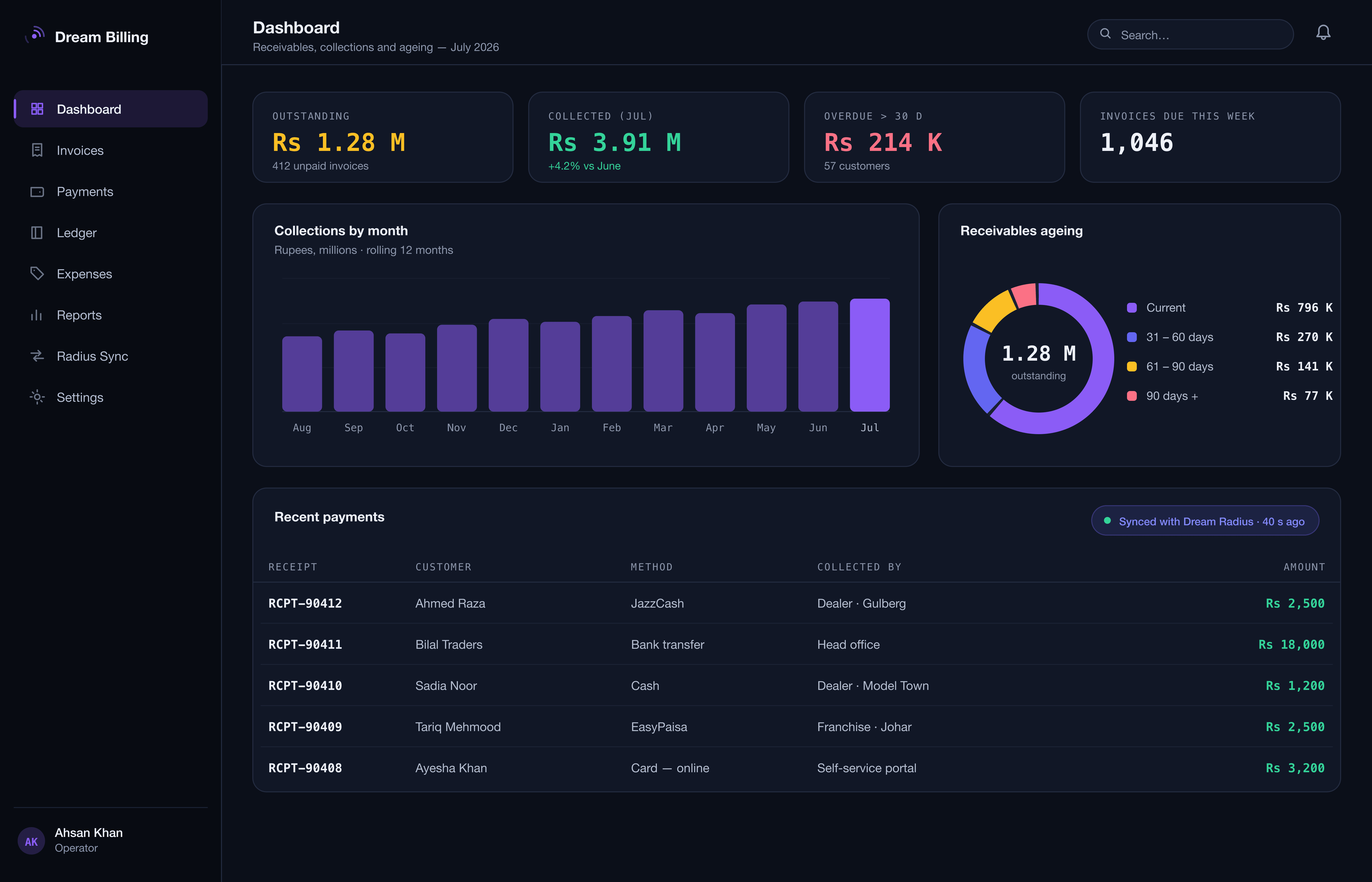
Dashboard
Outstanding, collected and overdue — with receivables ageing.
Representative screens — the shipping product's layout, with sample data.
Pricing · sold with Dream Radius
Dream Radius + Billing
The CRM that runs the network, plus the books that close the month.
Starter
$27/ month
- 1,000subscribers
- 1NAS devices
- 5billing staff accounts
- The complete product, every feature
Growth
$59/ month
- 5,000subscribers
- 2NAS devices
- 10billing staff accounts
- The complete product, every feature
Scale
$85/ month
- 10,000subscribers
- 3NAS devices
- 20billing staff accounts
- The complete product, every feature
Custom
Let's talk
- subscribers — sized to you
- NAS devices — sized to you
- billing staff accounts — sized to you
- The complete product, every feature
Included from Dream Radius
- All 8+ modules — RADIUS core to reporting
- All 6 reseller tiers, unlimited resellers
- Unlimited staff accounts with scoped permissions
- All 3 design themes, light & dark
- FreeRADIUS, PostgreSQL & Redis stack included
- Automatic renewals, expiry & dashboard crons
- Every update while your licence is active
Included from Dream Billing
- Automatic invoice runs from package expiries
- Receipts, part-payments and credit notes
- Per-customer ledgers and statements of account
- Expenses, categories and vendor records
- Sales tax / GST summaries ready to file
- Receivables ageing and collection reports
- Two-way Dream Radius sync included
FAQ
Billing questions, answered straight.
Do I have to buy all three products?
No. Dream Radius and NAT Syslog are licensed separately and each runs on its own. Dream Billing App is the exception: it bills from the subscribers Dream Radius manages, so it is only sold bundled with Dream Radius. Start with one product and add another whenever you need it — there is no re-platforming to do later.
What does Dream Billing App do that the CRM doesn't?
Dream Radius bills to keep the network running: packages, wallets and the invoices behind an activation. Dream Billing is the accounting side — customer ledgers with running balances, part-payments and credit notes, expenses against revenue, receivables ageing, and sales-tax summaries formatted to file. It's the difference between charging a customer and closing your books.
Does Dream Billing App require Dream Radius?
Yes. Dream Billing App reads its customers, packages and expiry dates from Dream Radius and writes payments back — without the CRM it has nothing to bill. That's why it is sold only as a Dream Radius + Billing bundle, or as part of all three.
How does the sync actually work?
Dream Billing reads customers, packages and expiry dates from Dream Radius over its API, and writes payments back. Recording a payment posts to the ledger, issues a receipt and extends the subscriber's RADIUS account — so reconnection happens without anyone touching the CRM.
Which payment methods can it record?
Whatever you actually take: cash collected by a dealer, JazzCash or EasyPaisa, bank transfer, or card through your own gateway. Dream Billing records and reconciles payments — it isn't a payment processor and never holds your money.
Can my accountant work in it?
That's the intent. Staff accounts are permission-scoped, so an accountant sees ledgers, expenses and tax reports without any access to the network side. Every report exports to CSV and PDF.
Where does Dream Billing App run?
On your own server, same as the other two — a self-contained Docker stack alongside your existing installation. Your customers, invoices and ledgers stay in a database you control.
Also from us
Two more products, sold separately.
Nothing here is a prerequisite for anything else. They simply happen to fit together when you run more than one.
Put your whole network under one radius.
A 30-minute walkthrough with your own topology on the table — hierarchy, billing and RADIUS included.